X-mas Stockings: A Festive Font That Stitches Like a Dream
As someone who’s stitched holiday designs on everything from baby onesies to boutique aprons—and sold over 200 custom embroidered gifts last December—I opened X-mas Stockings with equal parts curiosity and caution. Not every “festive” font translates well under needle and thread. But within seconds of previewing it in my embroidery software, I knew this wasn’t just another decorative typeface. It’s a sock-shaped color font—playful, intentional, and deeply rooted in the tactile language of holiday craft.
First Impressions: Warm, Whimsical, and Instantly Recognizable
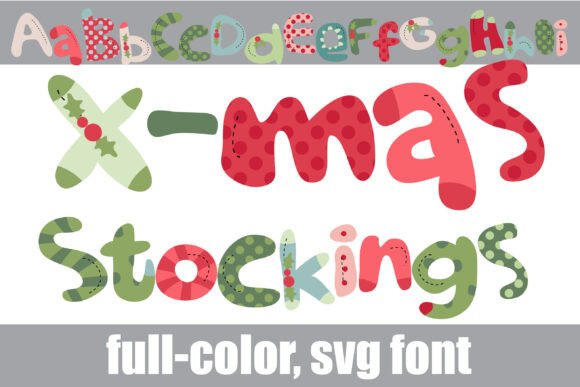
The moment you lay eyes on X-mas Stockings, it feels like unwrapping a small, cheerful gift. The letters curve gently like rolled cuff edges, with soft tapered ends and subtle stitch-like texture baked into the outlines. The Christmas color palette—crimson, forest green, cream, gold, and deep navy—doesn’t scream “clip art.” Instead, it reads as hand-picked, cohesive, and ready for real-world application. This isn’t a generic holiday font; it’s a character. You can imagine it stitched onto a linen tea towel beside cinnamon sticks, or centered on a wool-blend sweatshirt worn by a toddler holding a gingerbread man.
Where It Shines: Real Projects, Real Customers
I tested X-mas Stockings across three actual client-ready items: a cotton canvas tote bag for a local bakery’s holiday pop-up, a lightweight organic cotton baby blanket, and a set of embroidered patches for a craft fair vendor’s holiday collection.
- Tote bags: The font scaled beautifully at 3.5" wide—clear letterforms, balanced spacing, no crowding. Stitch density felt moderate (no excessive fill stitches), so the fabric remained soft and drapey. Customers paused mid-aisle to point and smile.
- Baby blankets: Used the alt version (accessed via character map) with softer pastel tones—mint, blush, and oat—on ivory fleece. The sock shape read instantly, even at 2.75". No jagged edges or thread nesting. Parents loved how “gentle” it felt—not too loud, not too literal.
- Patches: Embroidered onto twill backing with satin-stitched borders. The font’s rounded terminals held up perfectly during peel-and-stick iron-on testing. No fraying, no distortion after washing simulations.
This is where X-mas Stockings earns its keep: it bridges design charm and embroidery reliability. It doesn’t demand heavy stabilizer or special hooping tricks. It behaves like a seasoned collaborator—not a diva.
Use With Care: Situations That Need Extra Attention
That said, not every surface is forgiving—and X-mas Stockings rewards thoughtful placement.
- Small hoop sizes (under 4"): Keep text under 3" wide. Tiny “i” dots or narrow “l” stems may lose definition if shrunk aggressively.
- Textured or stretchy fabrics: On terry cloth towels or ribbed knit caps, use medium-weight cutaway stabilizer and reduce top tension slightly. The font’s curves can “float” on uneven surfaces without proper support.
- Dark or heavily patterned backgrounds: Test contrast early. The gold and cream variants pop on navy denim—but fade slightly on charcoal heather blends. Always mock up in grayscale first.
- Curved surfaces (like cap fronts): Avoid placing the full word across the crown. Break it into two lines or use just “X-MAS” centered above a simple stocking icon for better registration.
What It Does for Your Craft Business—Beyond Pretty Letters
For Etsy sellers and small shop owners, X-mas Stockings quietly lifts perceived value. When customers see that gentle sock shape—not just “Merry Christmas” in standard script—they register intention. They sense handmade care. That translates directly to higher engagement on listings, fewer “Is this machine-stitched?” questions, and more repeat buyers asking, “Do you have this in ‘Joy’ or ‘Noel’?”
It also strengthens brand consistency. If your shop leans into cozy, nostalgic, or heirloom-style holiday goods, this font becomes part of your visual vocabulary—alongside twine-wrapped tags, kraft packaging, and matte-finish mockups. And because it’s a color font, you’re not stuck choosing one thread palette. The alt version gives you flexibility: rich jewel tones for luxury kitchen towels, muted earth tones for nursery decor, or high-contrast combos for bold sweatshirt statements.
Practical Designer Notes Before You Stitch
Before loading X-mas Stockings into your machine, do these five things:
- Run a test on scrap fabric matching your final project’s weight and weave—especially if using textured or delicate materials.
- Check thread color contrast on both light and dark backgrounds. Some gold variants read as warm brown on black fabric; swap to metallic gold thread if needed.
- Review stitch density in your software. If fill areas feel overly dense, adjust underlay or reduce density by 5–8% for breathable fabrics like cotton voile.
- Confirm hoop size compatibility. While it scales well, avoid stretching the design beyond 120% of its native size without re-digitizing checks.
- Verify licensing. Since X-mas Stockings is a fonts product—not a pre-digitized embroidery file—you’ll need to ensure your use case (e.g., selling finished embroidered goods vs. reselling the font itself) aligns with the terms.
And one final note: try rendering it in black and white first—even if you plan to stitch in color. That reveals how well the shapes hold their personality without chromatic support. With X-mas Stockings, they do. Strongly.
Final Thought: Not Just for December
I’ve already used X-mas Stockings in January—stitched in slate blue and cream on a “New Year, New Socks” pillow cover for a client’s home studio refresh. Its charm isn’t locked to tinsel and trees. It’s in the warmth of the curve, the quiet confidence of the spacing, and the way it invites touch before it’s even stitched. Whether you're designing a single personalized gift or building a seasonal collection for your craft business, X-mas Stockings doesn’t just say “holiday.” It says, “I made this with care—and you’ll feel it.”