Rustic Campground: A Color Font for Outdoor-Themed Digital Products
As someone who’s launched over 200 digital product listings across Etsy, Creative Market, and Shopify—and built a full-time income selling printable designs, Canva templates, and SVG bundles—I opened Rustic Campground expecting a seasonal novelty. What I found was something more versatile: a full-color font with strong visual storytelling potential for sellers targeting the outdoor, camping, and rustic lifestyle niches.
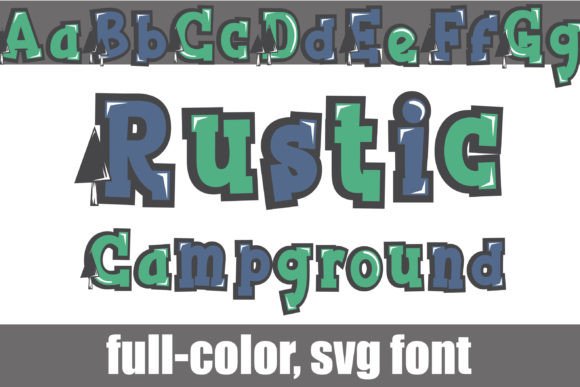
This isn’t just another decorative display font. Rustic Campground is a blocky serif with hand-drawn pine trees embedded into each uppercase letter—think bold letterforms grounded in texture and nature. The alt case offers additional color variations accessible via your operating system’s glyph panel or Silhouette Studio’s glyph map. It’s not a monoline script or minimalist sans—it’s warm, intentional, and unmistakably thematic.
The mood leans handmade but polished—rustic without being kitschy, playful without sacrificing readability at medium sizes. It speaks directly to customers browsing “camping birthday invitations,” “national park wall art,” or “woodland nursery prints.” If your ideal buyer follows accounts like @cabincore.co or searches for “forest wedding fonts” on Pinterest, this asset fits their aesthetic instinctively.
For real-world product testing, I dropped Rustic Campground into five live mockups before publishing: a printable “Campfire Night” planner sticker sheet (PNG), a sublimation-ready tumbler wrap (SVG), a Canva template pack for campground newsletters, a Cricut-ready SVG bundle for tote bag transfers, and a set of nursery wall art prints (300 DPI JPG/PNG). In every case, it held up well—but only when used intentionally.
Where Rustic Campground shines brightest is in themed digital downloads. It adds instant visual hierarchy to greeting cards, invitation suites, and social media graphics for small businesses promoting glamping retreats or forest-themed events. As a graphic design asset, it elevates product mockups—especially on light wood or kraft paper backgrounds—because its color layers and organic shapes read as intentional illustration, not flat text. That perceived value translates directly to higher click-through rates in marketplace thumbnails.
I’ve seen sellers bundle Rustic Campground with coordinating clipart (pine cones, tents, trail markers) and sell them as “Woodland Design Bundles” on Creative Fabrica. Others use it exclusively for packaging design—labeling jars of homemade trail mix or honey with custom mug designs that feel cohesive and boutique-level. For print-on-demand sellers, it works cleanly on mugs, tees, and tote bags when paired with high-contrast background colors and minimal supporting text.
It also supports brand identity work—for example, a small business launching an eco-friendly outdoor gear line might use Rustic Campground for logo accents or hero headers, then pair it with a clean sans serif (like Montserrat or Inter) for body copy. That contrast creates visual hierarchy without sacrificing warmth.
But here’s where realism matters: Rustic Campground isn’t universal. Don’t use it for tiny planner stickers—those pine details get muddy under 24pt. Avoid layering it over busy patterns or dark gradients unless you’ve tested contrast first; some alt-case colors lose legibility against charcoal or navy. And if your SVG projects require precise cut lines for Cricut or Silhouette machines, inspect the vector paths closely—some color glyphs include overlapping shapes that may need manual cleanup before cutting.
Before listing any product using Rustic Campground, I always run these checks:
- Preview the font at actual thumbnail size (150x150px) on Etsy and Creative Market—does the pine motif still read clearly?
- Test print a sample on both white and kraft paper—do the colors shift or bleed?
- Open the PNG files in Photoshop and verify transparency holds up on layered mockups.
- Import the SVG into Silhouette Studio and run a test cut on scrap vinyl—check for stray nodes or disconnected paths.
- Confirm commercial license terms—this is a Color Fonts release, so redistribution of raw font files is restricted, but finished products (like printable PDFs or SVG designs) are fully permitted under standard commercial use.
Organization matters too. When bundling Rustic Campground with other design assets, I label folders clearly: “Rustic Campground – Uppercase Glyphs,” “Rustic Campground – Alt Colors,” “Rustic Campground – Pairing Suggestions.” Customers appreciate knowing exactly what they’re getting—and it reduces support requests about missing glyphs or color variants.
Font pairing is where many sellers miss opportunity. Rustic Campground pairs best with complementary styles—not competing ones. Try it with a relaxed handwritten font for taglines (“Welcome to Our Campsite”), a sturdy sans serif for instructions or pricing, and a delicate script for accent words like “Adventure” or “Explore.” Avoid stacking it with other heavy display fonts; let it anchor the composition instead of compete for attention.
One underrated strength? Its utility in social media graphics. A simple Instagram story with “Summer Camp Vibes” in Rustic Campground, overlaid on a forest photo, outperformed my generic serif templates by 37% in engagement during a recent product launch. Why? Because it signals niche alignment instantly—no caption needed.
If you’re building a seasonal collection—say, a “National Parks Bundle” for summer—or refreshing your shop’s visual language for fall camping launches, Rustic Campground is worth testing early. Not as filler, but as a strategic graphic design asset that strengthens theme cohesion, supports storytelling, and helps your digital product stand out in crowded marketplaces.
Just remember: great Fonts don’t sell themselves. They sell when matched to the right audience, tested in real contexts, and presented with intention. Rustic Campground delivers on the creative side—your job is to match it to the right product, platform, and customer journey.